Most people hear their doctor mention a code during a visit and think nothing of it. But that small code on your medical file? It can change everything. From insurance approvals to the medicine you receive, the hypothyroidism ICD 10 code plays a bigger role than most patients ever realize.
If you have been diagnosed with a thyroid condition, understanding this code is not just useful. It is necessary.
Why a Simple Code Carries So Much Weight
The ICD 10 stands for International Classification of Diseases, 10th edition. It is a global system used by doctors, hospitals, and insurance companies to assign a specific code to every known health condition.
For hypothyroidism, the ICD 10 code is E03.9. This is the most commonly used code. It means hypothyroidism that is unspecified, which tells the system your thyroid is underactive, but no specific cause has been confirmed yet.
Here is what surprises many patients: there is not just one hypothyroidism ICD 10 code. There are several, each telling a different story about your health.
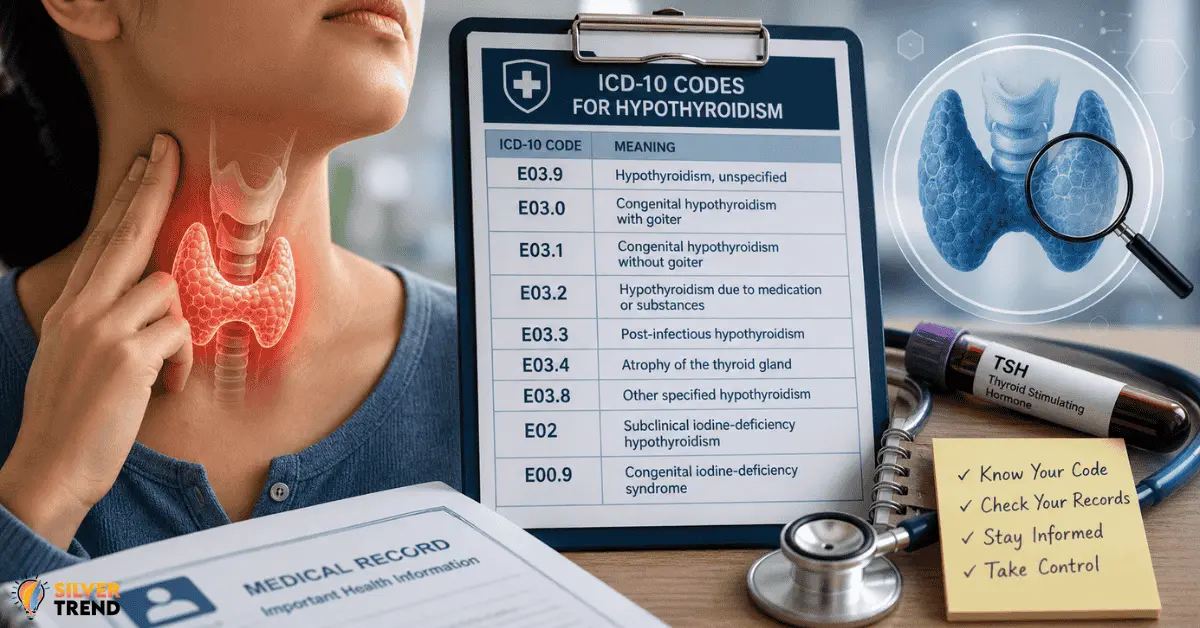
The Full List of Hypothyroidism ICD 10 Codes
This is where things get very important. Your doctor chooses the code based on your exact condition. The wrong code can delay treatment or cause insurance problems.
| ICD 10 Code | Meaning |
| E03.9 | Hypothyroidism, unspecified |
| E03.0 | Congenital hypothyroidism with goiter |
| E03.1 | Congenital hypothyroidism without goiter |
| E03.2 | Hypothyroidism due to medication or substances |
| E03.3 | Post-infectious hypothyroidism |
| E03.4 | Atrophy of the thyroid gland |
| E03.8 | Other specified hypothyroidism |
| E02 | Subclinical iodine-deficiency hypothyroidism |
| E00.9 | Congenital iodine-deficiency syndrome |
Most adults with a slow thyroid are initially assigned the E03.9 code. But as testing continues, the code can be refined into something more specific.
How the Wrong Code Can Hurt You
Here is something most online articles skip. If your hypothyroidism ICD 10 code is not accurate, you might face real problems.
For example, if your condition is caused by a medication you are taking and your doctor codes it as E03.9 rather than E03.2, your insurance may not cover the appropriate treatment plan. Some medications are only approved for specific coded conditions.
Also, subclinical hypothyroidism, which has its own code E02, is treated differently from full hypothyroidism. If your labs show borderline thyroid levels but you are coded incorrectly, you might not get the monitoring or early treatment that you need.
This is why patients should feel comfortable asking their doctor: “What ICD 10 code is being used for my diagnosis?”

Hashimoto’s Disease and Its Separate Code
Many people with hypothyroidism actually have Hashimoto’s thyroiditis. This is an autoimmune condition where the body attacks the thyroid gland. It has its own ICD-10 code: E06.3.
This matters because Hashimoto’s is managed slightly differently. Some patients need regular antibody testing. Some benefit from a gluten-reduced diet. Others need more frequent TSH monitoring.
If you have Hashimoto’s but your file only shows E03.9, your doctor might not flag you for these extra checks. Ask specifically if your autoimmune status has been coded correctly.
What Happens After You Get Coded
Once your hypothyroidism ICD 10 code is in the system, it follows your medical records. Every lab order, prescription refill, and specialist referral will reference that code.
Your pharmacy uses it to process levothyroxine refills. Your endocrinologist checks it before deciding how often to test your TSH. Even life insurance and disability applications may reference your ICD 10 history.
Think of it as a medical identity for your condition. It speaks on your behalf when you are not in the room.
Practical Steps Every Hypothyroid Patient Should Take
You do not need to be a medical expert to protect yourself. A few simple actions go a long way.
- Ask for your code in writing. After each diagnosis update, ask your doctor what ICD 10 code is listed. You have the right to know.
- Check your explanation of benefits. When your insurance sends a statement, the ICD code is usually listed. Make sure it matches your actual condition.
- Update your records if your diagnosis changes. If you are later confirmed with Hashimoto’s or a drug-induced thyroid issue, ask your doctor to update the code.
- Keep a personal health file. Store your diagnosis codes, lab results, and medication history in one place. This makes transitions between doctors much smoother.
The Bigger Picture Behind These Numbers
Hypothyroidism is one of the most common hormonal conditions in the world. Millions of people are diagnosed every year. Yet so few know the details behind the hypothyroidism ICD 10 system that quietly shapes their care.
You deserve to understand your own diagnosis. Not just the symptoms or the medication. But the actual classification your healthcare system uses to describe your health.
The next time you sit in that doctor’s office and hear a code mentioned, do not let it pass without asking questions. That small alphanumeric label is carrying your story through an entire medical system.
Make sure it is telling the right one.