Most creators never think about protecting their work until it is too late. A musician uploads a song. A designer shares an artwork. A writer publishes a story. Then someone else copies it, claims it, and profits from it. The original creator is left with nothing but frustration.
This is not a rare problem. It happens every single day across the internet. But blockchain in intellectual property is quietly changing this reality. And most people have no idea how deep this change goes.
Why Traditional IP Protection Often Fails Creators
Copyright laws exist. Patent systems exist. Trademark offices exist. Yet creators still lose ownership battles all the time. Why?
The current system relies on paper records, slow processes, and expensive legal help. Proving you created something first is harder than it sounds. Files get copied. Dates get disputed. Lawyers get expensive.
Small creators and independent artists suffer the most. They cannot afford long legal fights. So they give up. The person who copies wins simply because they have more money or patience.
This is the real problem. Not a lack of laws, but a lack of proof that is fast, cheap, and impossible to fake.
How Blockchain Changes the Rules
Blockchain is a digital record system. Think of it like a public notebook that thousands of computers share. Once you write something in it, nobody can erase or change it.
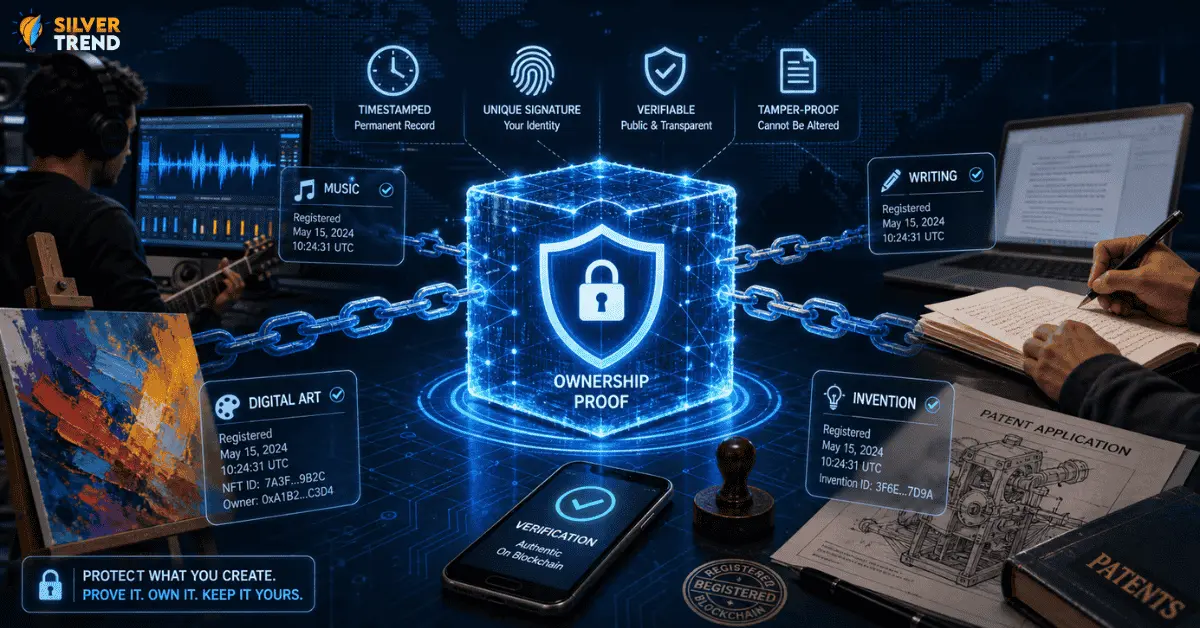
When you register your creative work on a blockchain, it gets a timestamp and a unique digital signature. This signature proves two things: what you created and exactly when you created it.
No lawyer needed. No government office. No waiting months for approval.
Blockchain in intellectual property gives creators something powerful: a permanent, public, and tamper-proof record of ownership. This single shift changes how copyright and patents work at a very practical level.
Real Examples You Probably Did Not Know About
Music and Sound Recordings
Platforms built on blockchain now let musicians register their songs the moment they finish recording. Every stream, every download, every use gets tracked automatically. Royalty payments happen without an intermediary. Artists get paid faster and more fairly.
Before blockchain, a song could be used in a commercial for months without the artist knowing. By the time they found out, tracing the money was nearly impossible.
Visual Art and NFTs
Non-fungible tokens, or NFTs, made headlines mostly for their prices. But the real story is the technology beneath the surface. NFTs use blockchain in intellectual property to prove the authenticity of digital art. Each piece has a traceable ownership history.
When a digital painting is sold, the blockchain records the sale. The new owner can prove the work is genuine. The original artist can receive automatic royalties on every future sale. This kind of system never existed before.

Patents and Inventions
Patent systems are slow. Filing a patent can take years. During that time, someone else might file a similar idea, leading to a legal dispute. Blockchain helps inventors create an instant, dated proof of their invention. This does not replace patents. But it provides inventors with strong supporting evidence if a dispute ever arises.
What Blockchain in Intellectual Property Actually Protects
Here is something most articles skip: blockchain does not automatically protect everything. It protects proof. That is a subtle but important difference.
When you log your work on a blockchain:
- You create a dated record of what existed and when
- You attach your identity to that record
- You make it visible and verifiable to anyone
- You prevent others from backdating competing claims
This proof becomes your strongest tool in any dispute. Courts and legal systems are beginning to accept blockchain records as credible evidence. That acceptance is growing every year.
Challenges That Still Exist
Blockchain in intellectual property is not perfect yet. A few honest challenges remain.
Legal recognition varies by country. Some nations accept blockchain timestamps as legal evidence. Others are still debating. If you work across borders, this can get complicated.
Uploading a copy is not the same as owning the original. If someone copies your work and registers it on a blockchain before you do, they get the timestamp. First to register still matters. So act fast.
Technology literacy is a barrier. Not every creator knows how to use blockchain tools. The process is getting simpler, but it still takes effort to learn.
These challenges are real. But they are shrinking every year as adoption grows and laws adapt.
What Creators Should Do Right Now
You do not need to wait for perfect systems. Here is a practical approach:
Start by exploring platforms like Bernstein, IPwe, or Myco that offer blockchain-based IP registration. Some are free or low-cost for basic use.
Register your work early. The moment you finish creating something valuable, log it. Do not wait.
Keep your original files with metadata intact. Blockchain records pair well with traditional file evidence.
Learn basic blockchain concepts. You do not need to be a developer. Understanding how digital ownership works helps you better protect yourself.
Blockchain in intellectual property is not just a tech trend for big companies. It is a practical tool that everyday creators can use right now. The gap between creation and protection has never been smaller. What you build deserves to stay yours.