Imagine launching an AI tool for your small business. You spend months building it. Then one morning, you get a legal notice. Your tool breaks new EU rules. You had no idea. This is not a made-up story. It is happening to real businesses right now. That is why following the EU AI Act news today matters more than ever.
The EU AI Act is moving fast in 2026. Things are changing every few weeks. If you are not paying attention, you could fall behind or even face serious fines.
Why EU AI Act News Today Is Changing Everything
The EU AI Act officially started rolling out in phases. The first major phase began in February 2025. But the bigger and more powerful rules are kicking in throughout 2025 and 2026. This is where things get serious.
The Act puts AI systems at risk. Low risk, limited risk, high risk, and banned. Each group has different rules. High-risk AI tools, like those used in hiring, education, or medical care, face the strictest rules.
What is new in 2026? Regulators are now actively checking compliance. Before, it was mostly preparation. Now it is enforcement.
Here is what has changed recently:
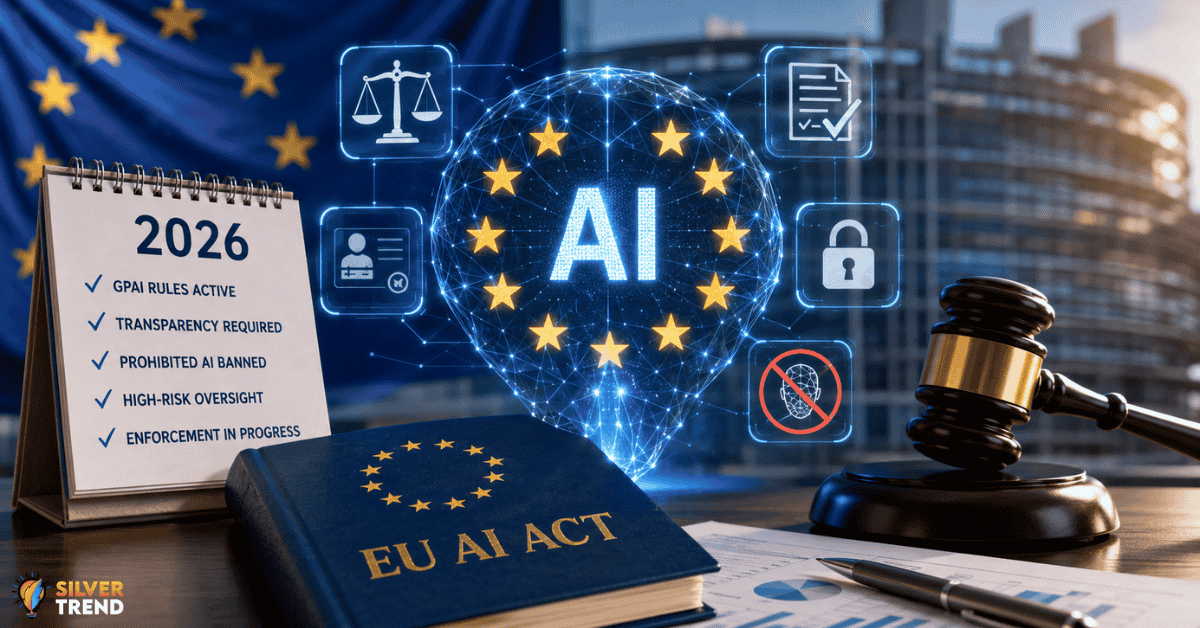
- General Purpose AI (GPAI) rules are now fully active. Any company that makes a large AI model used across many tasks must register it and share safety information.
- Transparency rules require AI systems to tell users they are talking to a machine. Chatbots and AI voices must clearly disclose this.
- Prohibited AI systems are now officially banned. This includes social scoring systems and certain real-time biometric tools in public spaces.
These are not small updates. These are real shifts with legal teeth.
What Real Businesses Are Facing Right Now
Following the EU AI Act news today gives you a clear picture of what is happening on the ground. Many companies are scrambling. Some are hiring AI compliance officers for the first time. Others are pausing product launches to review their AI systems.
Small businesses feel it differently. A startup using an AI hiring tool, for example, may now need to bias audits and keep detailed records. That costs time and money.
Large companies face a different challenge. They have many AI systems across teams. Updating each one to meet EU standards is a massive project.
One surprising development in recent EU AI Act news today is how fast regulators are moving. The EU AI Office, set up to oversee enforcement, is already investigating several companies. This is faster than many experts expected.
Banks and healthcare firms are especially under pressure. AI tools used for loan decisions or patient triage fall under the high-risk category. These companies must now prove their AI is fair, explainable, and safe before using it.

The Global Ripple Effect
Here is something many people miss when following EU AI Act news today. This law is not just for Europe.
Any company that sells products or services in the EU must follow the rules. That includes companies based in the US, India, China, or anywhere else. If your AI touches European users, you are in scope.
This is called the Brussels Effect. Europe sets the standard. The world often follows. We already saw this with GDPR for data privacy. The EU AI Act could do the same for artificial intelligence.
Several countries are now watching Europe closely. Some are already copying parts of the Act into their own laws. This means EU AI Act news today is becoming global AI regulation news.
Three Things to Watch in the Next 6 Months
If you want to stay ahead, here are the key things to monitor right now.
- GPAI Model Audits Large AI models will face independent safety audits. The first round of audits is expected to finish by late 2026. Results will be public.
- Notified Body Approvals: High-risk AI systems need approval from certified testing bodies. Not many of these bodies exist yet. There could be bottlenecks and delays.
- Complaint Mechanisms Users now have the right to complain about AI decisions. Companies must have systems to handle these complaints. Many do not yet. Expect this to become a hot topic.
What You Should Do Right Now
Reading EU AI Act news today is step one. Acting on it is step two.
If you use AI in your work or business, find out what risk category it falls under. The EU has a free online tool to help with this. If you are in the high-risk group, start building your documentation now.
If you are a developer, read the technical standards being published by the European standards bodies. These will guide what compliance looks like in practice.
And if you are just curious, keep watching. The EU AI Act is shaping the future of AI in ways we are only starting to understand.
EU AI Act news today is not just news. It is a preview of how AI will work everywhere. The companies and people who pay attention now will be far better prepared for what comes next.