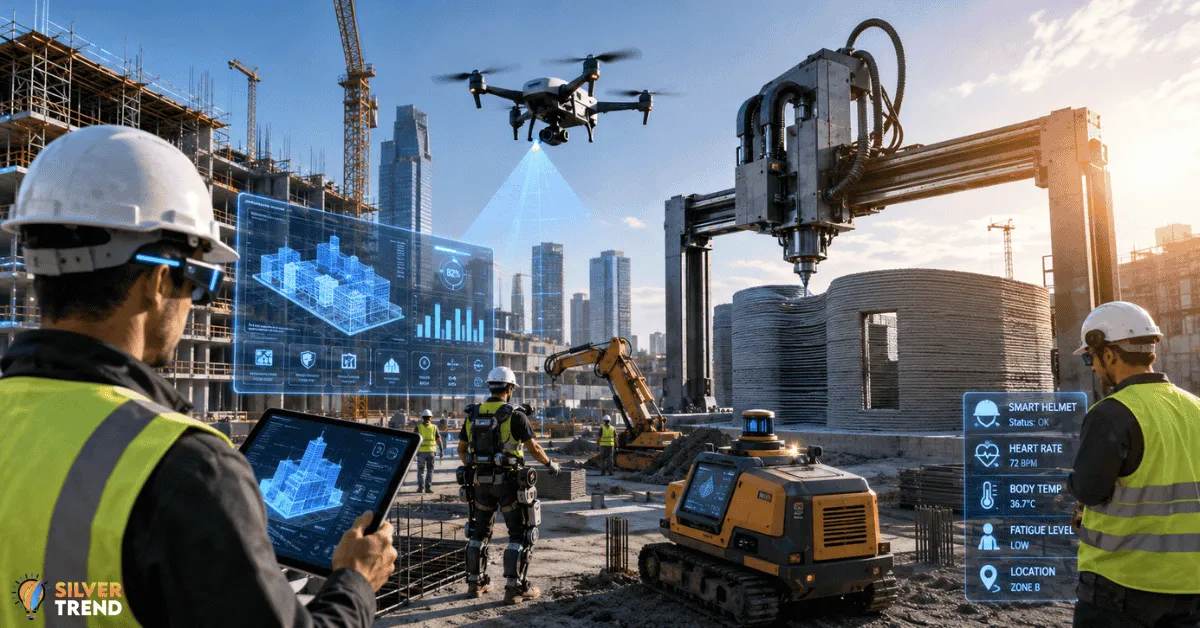
Walk past any major building site today, and something feels different. The noise is still there. The dust is still there. But look closer. You will spot drones flying overhead. You will see workers wearing smart helmets. You will notice machines moving without a human driving them. Construction technology news is not just about gadgets anymore. It is about a complete shift in how the world builds things.
This change is happening fast. And most people outside the industry have no idea.
The Machines That Replaced Guesswork
For decades, construction relied on experience and gut feeling. A supervisor would look at a crack in the concrete and make a judgment call. A project manager would estimate delays based on past jobs. That era is ending.
Today, AI-powered software reads thousands of data points every hour. It flags risks before they become problems. It tells you where a pipe might fail before the wall goes up. Construction technology news from this year shows that predictive tools have cut rework costs by up to 30 percent on some large projects.
That is not a small number. Rework is one of the biggest budget killers in construction. Fixing mistakes after the fact wastes time, money, and materials. When software catches the problem at the design stage, the savings are real and immediate.
Smart Materials Are Getting Serious Attention
One of the most exciting areas in current construction technology news is smart materials. These are not science fiction anymore.
Self-healing concrete is now being tested on roads and bridges in several countries. Tiny capsules inside the concrete break open when a crack forms. They release a material that automatically fills the gap. No crew needed—no road closure required.
Thermochromic glass is another example. It changes its tint based on temperature. Buildings using this glass use less energy for cooling. That directly reduces electricity bills and carbon footprint. Some commercial buildings in Europe are already reporting 20 percent drops in cooling costs.
These materials do not just perform better. They also reduce long-term maintenance costs. That matters a lot for government projects and large commercial developers who think in decades, not quarters.
Drones Are Now Project Managers in the Sky
A few years ago, drones were mostly used for photos and marketing videos. Today, construction sites use them for daily progress tracking, safety checks, and even material delivery on smaller sites.
Here is what makes this truly valuable. A drone can scan an entire site in under 20 minutes. It creates a 3D model of what has been built so far. Project managers compare that model against the original design. If something is off by even a few centimeters, they know immediately.
This level of detail used to take a full survey team several days to complete. Now it takes one drone and one operator. Construction technology news platforms report that sites using drones for weekly scans are completing projects 15 to 20 percent faster on average.
That is a massive shift in the speed of project delivery.

Workers Are Wearing Technology
Hard hats are not just hard hats anymore. Smart helmets now track a worker’s location, body temperature, and fatigue levels. If a worker has been in a high-heat zone too long, the system sends an alert. If someone falls, supervisors are notified within seconds.
Exoskeletons are also entering job sites in bigger numbers. These are wearable frames that support a worker’s back and legs during heavy lifting. They reduce injury risk significantly. For construction companies dealing with labor shortages, keeping experienced workers healthy longer is a major priority.
The human side of construction technology news often gets ignored. People focus on robots and software. But tools that protect workers and extend their careers matter just as much.
3D Printing Is Building Real Homes
The most visible example of construction technology news this year has been 3D-printed housing. Entire homes are being printed in under 48 hours in some cases. The printer lays down layer after layer of a special concrete mix. The result is a solid, livable structure.
This is no longer a concept project. Companies in the United States, India, and Kenya have built hundreds of these homes. Some are being sold to buyers as permanent residences. Others are being used as emergency housing after natural disasters.
Cost is the big story here. A 3D-printed home can cost 30 to 40 percent less than a traditionally built one. For regions dealing with housing shortages, this technology offers a real path forward.
Why This Moment Matters More Than People Realize
Construction is one of the largest industries in the world. It affects every other industry. When buildings go up faster and cost less, everything from hospitals to schools to affordable housing becomes more accessible.
Construction technology news is not just news for contractors and engineers. It is news for anyone who lives in a building, uses a road, or crosses a bridge. That is everyone.
The pace of change in this space has never been faster. New tools are being tested and adopted at a rate that was unimaginable even five years ago. Staying informed about construction technology news means understanding where the world is physically heading next.
The job site of the future is already under construction. It started this year.