What if the smartphone is no longer the center of your digital life? That idea once sounded impossible. Today, many of the world’s biggest technology companies are working toward exactly that future. The way we use technology may change faster than many people expect.
The phrase “tech giants envision future beyond smartphones” is becoming more than a prediction. It is turning into a real industry goal. Companies are investing billions into new devices, artificial intelligence, and wearable technology that could reduce our dependence on traditional phones.
A New Race Is Quietly Taking Shape
For years, smartphones ruled everything. They became cameras, maps, wallets, and communication hubs. Yet many technology leaders believe the next major shift is already starting.
Instead of looking down at screens all day, future devices may blend naturally into daily life. Smart glasses, AI assistants, voice interfaces, and spatial computing systems are leading this change. Several major companies are actively developing products designed to move computing beyond handheld devices.
This is why the topic tech giants envision future beyond smartphones keeps appearing in technology discussions worldwide.
Smart Glasses Could Become the New Screen
Many experts believe smart glasses have the strongest chance of becoming the next big platform.
Unlike phones, glasses keep information directly in your field of view. You can receive directions, messages, and reminders without pulling a device from your pocket. New designs focus on lightweight frames and built-in displays that feel natural during everyday use.
Several companies are exploring this direction:
- Apple is reportedly working on AI-powered glasses.
- Google continues expanding its XR ecosystem.
- Snap plans advanced AR glasses.
- Other brands are testing AI eyewear concepts.
The goal is simple. Technology should stay available without demanding constant attention.
Why Glasses Have an Advantage
Smartphones require users to stop and interact with a screen. Glasses can provide information instantly.
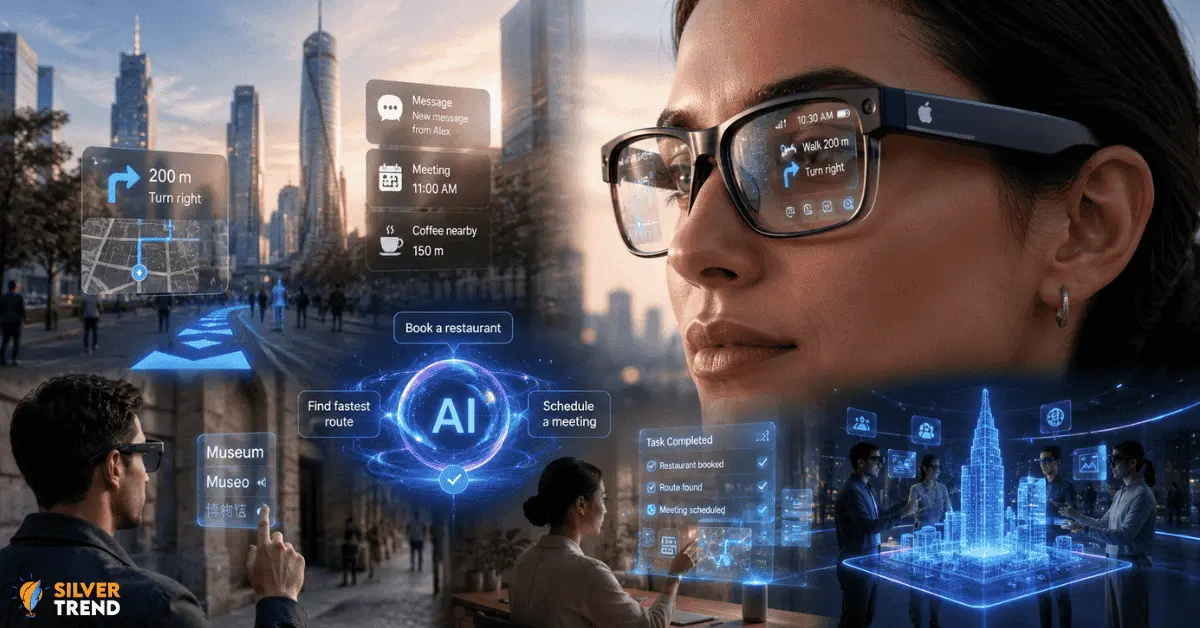
Imagine walking through a city and seeing navigation arrows appear naturally in front of you. Imagine translating signs while traveling or getting shopping recommendations while browsing stores.
These experiences could make technology feel less separate from daily life. That vision is a major reason why tech giants envision future beyond smartphones through wearable devices.

AI May Matter More Than Hardware
The biggest change may not be the device itself. It may be artificial intelligence.
Traditional smartphones depend on apps. You open one app for weather, another for maps, and another for messages. New AI systems aim to remove those steps.
Instead of switching between apps, users may simply ask an AI assistant for help. The system could complete tasks automatically, gather information, and handle requests across different services. Microsoft’s Project Solara highlights this growing shift toward agent-based computing.
This approach saves time and reduces screen use.
For example, a user could say:
- Book a restaurant.
- Find the fastest route.
- Schedule a meeting.
The AI could complete all three tasks without opening separate applications.
Spatial Computing Changes the Experience
Another important idea is spatial computing.
Rather than interacting through flat screens, users interact with digital content placed around them in real space. Headsets and future wearable devices can combine the physical and digital worlds into one experience.
This creates opportunities for:
- Education
- Remote work
- Design projects
- Gaming
- Virtual collaboration
A student could view a floating science model. An architect could examine a building design in three dimensions. Teams in different countries could work together inside shared digital spaces.
These possibilities help explain why tech giants envision future beyond smartphones through spatial computing platforms.
The Hidden Challenges Ahead
The transition will not happen overnight.
People already depend heavily on smartphones. New devices must offer clear advantages before users change habits. Battery life, comfort, affordability, and privacy remain major concerns.
Privacy is especially important. Many future devices may collect visual and environmental information throughout the day. Companies must build trust while creating useful experiences. Experts continue discussing how wearable AI can balance convenience with responsible data use.
Another challenge involves social acceptance. Smartphones became normal because everyone carried them. Smart glasses and similar devices must fit naturally into everyday life before mass adoption can occur.
Looking Toward 2026 and Beyond
History shows that technology evolves in waves. Desktop computers led to laptops. Laptops led to smartphones. The next step may involve multiple connected devices working together rather than a single dominant device.
The phrase “tech giants envision future beyond smartphones” reflects a broader shift in thinking. The future may include smart glasses, AI companions, spatial computing systems, and devices that fade into the background while helping people stay connected.
Smartphones will not disappear tomorrow. However, their role may gradually shrink as newer technologies become smarter, lighter, and more helpful. The companies building tomorrow’s products are preparing for that possibility today, and the results could reshape everyday life in ways many people have not yet imagined.