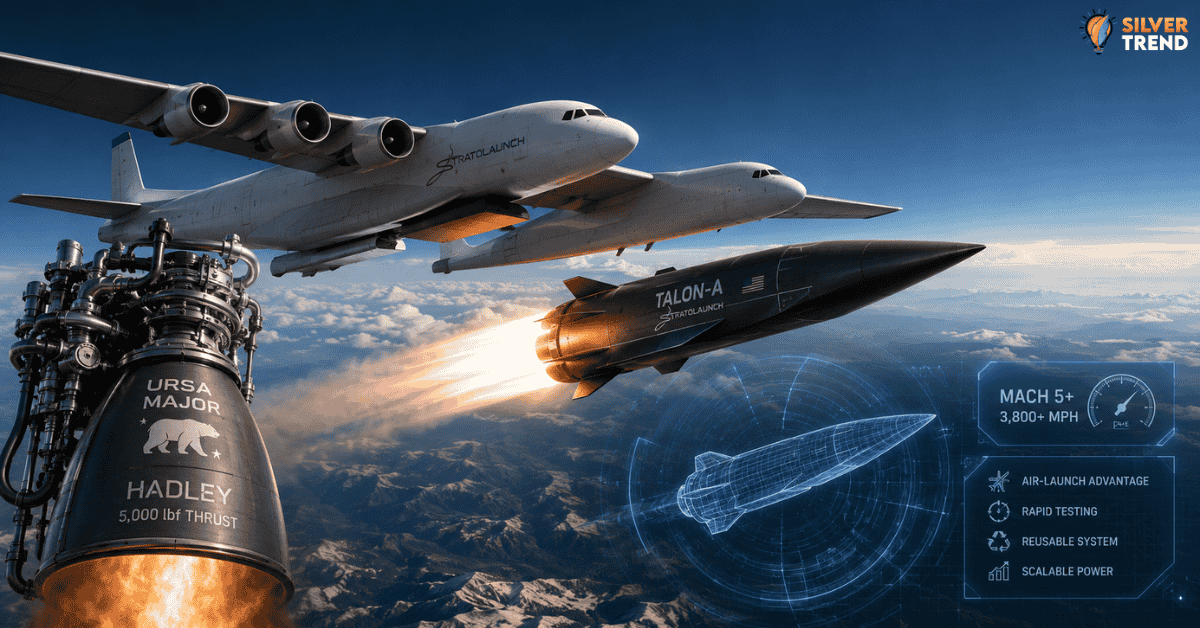
Picture a rocket engine so powerful it can push a vehicle past Mach 5 in seconds. That is not science fiction anymore. The partnership between Ursa Major and Stratolaunch is making this real. Ursa Major Stratolaunch hypersonic technology is one of the most exciting developments in aerospace right now. And most people have no idea how deep this goes.
Why This Partnership Changes Everything
Stratolaunch is famous for building massive aircraft that carry rockets into the sky. Their plane, Roc, is the largest in the world by wingspan. But Roc alone is not enough. You need powerful engines to push hypersonic vehicles to extreme speeds.
That is where Ursa Major steps in.
Ursa Major is an American rocket propulsion company. They build engines that run on liquid oxygen and kerosene. Their engines are known for being fast to make and highly reliable. The Ursa Major Stratolaunch hypersonic technology project pairs Ursa Major’s Hadley engine line with Stratolaunch’s air-launch system.
This combination is powerful for one big reason. Air-launching means the rocket does not start from the ground. It launches from high altitude, already moving fast. This gives hypersonic test vehicles a head start. Less fuel is wasted fighting gravity and the thick lower atmosphere. The engine can focus its power on reaching hypersonic speeds instead.
Most hypersonic programs need massive ground launch pads. Ursa Major Stratolaunch hypersonic technology skips that problem entirely. The result is a more flexible and cost-effective way to test and develop hypersonic vehicles.

How the Engines Actually Work
Ursa Major’s engines use a process called liquid bipropellant combustion. Liquid oxygen and RP-1 fuel burn together at very high pressure. This creates a massive, controlled explosion that propels the vehicle forward.
The Hadley engine produces around 5,000 pounds of thrust. It is compact and designed for rapid production. Ursa Major can build these engines quickly using modern manufacturing methods. This speed is critical for hypersonic programs that need to test frequently.
Here is what makes Ursa Major Stratolaunch hypersonic technology stand out from other programs:
- Reusability focus: The system is built to fly, recover, and fly again.
- High cadence testing: More tests mean faster learning and better vehicles.
- Scalable design: Ursa Major engines can be clustered for more thrust as needed.
- Air-launch flexibility: Roc can take off from almost any large runway.
Traditional hypersonic programs take years between tests. Ursa Major Stratolaunch hypersonic technology aims to change that timeline dramatically.
The Real-World Impact in 2026
Hypersonic vehicles travel faster than Mach 5. That means over 3,800 miles per hour. At those speeds, materials heat up to extreme temperatures. Air behaves differently. Normal control systems stop working the way you expect.
Testing at these speeds used to require huge resources. Only a few nations in the world could afford it regularly. Ursa Major Stratolaunch hypersonic technology is lowering that barrier. This matters for both defense and civilian applications.
Defense and National Security
The United States military needs fast, reliable hypersonic vehicles. Missiles, glide vehicles, and reconnaissance platforms all benefit from hypersonic capability. Ursa Major Stratolaunch hypersonic technology provides the testing infrastructure the military needs to develop and prove these systems faster.
Stratolaunch already has a history of contracts with defense-related agencies. Adding Ursa Major’s engine expertise tightens the loop between design, test, and deployment.
What Comes Next
The Talon-A vehicle is Stratolaunch’s reusable hypersonic test platform. It has already completed early flight tests. As Ursa Major Stratolaunch hypersonic technology matures, Talon-A will carry more advanced payloads. Researchers can test new heat shields, guidance systems, and propulsion concepts at real hypersonic speeds.
This kind of live testing is something no wind tunnel or simulation can fully replace. Real flight data is irreplaceable. And with a system that can fly repeatedly from a standard runway, the data can keep coming.
The speed of iteration here is the hidden advantage. Every flight teaches engineers something new. Every recovered vehicle carries data that improves the next design. Ursa Major Stratolaunch hypersonic technology creates a learning loop that slower programs simply cannot match.
Most people focus on the raw speed numbers when they talk about hypersonic tech. The real story is how often you can test, how cheaply you can learn, and how quickly you can fix problems. That is exactly what this partnership was built to solve.
Ursa Major Stratolaunch hypersonic technology is not just fast. It is smart, flexible, and built for the long game. In a world where hypersonic capability is becoming a strategic priority, this program may prove to be one of the most important investments in American aerospace of this decade.
The sky is no longer the limit. At Mach 5 and beyond, it is just the beginning.